
Investigating a potential project
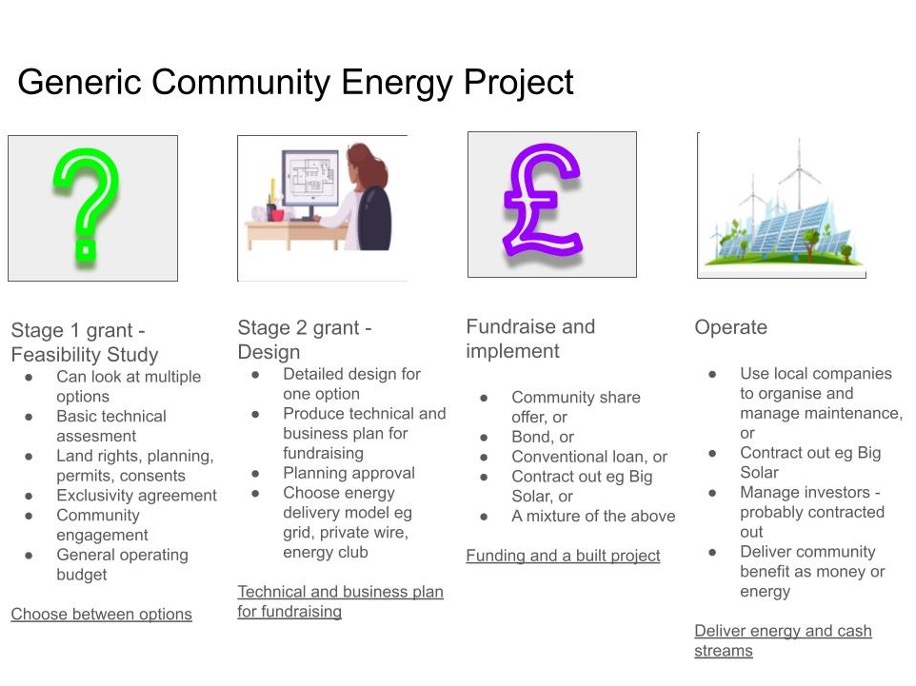
The Great British Energy Community Fund makes grants available to community energy organisations to investigate the feasibility of successfully developing a community-scale, community-owned energy related project or programme in two stages (stage 1 and stage 2).
Stage 2 only applies to asset based projects and moves on from a feasibility study to create a design suitable for funding and implementing.After stage 2 there is a full design and business plan for which funding can be sought.
Stage 1
The boundary between the two stages is not rigid – some tasks can be in either of the stages, but a project would start at stage 1 and have these sorts of deliverables:
-
- Statement of need for the project, and the benefit it might bring to the defined community eg The CH64 post code in NCE’s case,
- Technical assessment of the sizing and technology use for (potentially) a range of options. The assessment will include (for instance) visual appearance and glint analysis for solar panels since this affects community approval (and other things). There is also consultation with the DNO about options to connect to the grid,
- An analysis of land rights, planning, permits and consents needed. It would normally require heads of terms agreement with land/property owners that they agree in principle to the project. It would usually also include an exclusivity agreement that the land/property owner that they will not use the results of the study to pursue a commercial arrangement, since this would be something of a mis-use of the grant money,
- A report on the way that the community has been engaged with the plan and their general acceptance of it,
- A report on how the community is expected to benefit from the plan.
General financial projections. There may be several options here, it’s not necessary to decide between them. All of them must provide a defined community benefit.
Some options will be the usual commercial options like:
-
-
- The electricity is used by the property hosting the project,
- Exporting electricity to the grid,
- Entering into a private wire agreement where a local business uses the generated electricity.
-
Other options are becoming available to Community Energy organisations including:
-
-
- Energy Clubs which can be formed from at least 1 generator and 1 customer within a local area where energy exported by the generator(s) is deemed to be used by the customer(s) directly. The club sets the tariffs for both generation and consumption. An Energy Club avoids many of the levies placed on generators so that the generator receives a very high proportion of what the consumers pay. The elimination of levies and middlemen increases the payment to the generators while decreasing what consumers pay.
- Potential legal, operational and governance structures. Again, options.
-
The end result is enough information to choose between options, to have a reasonable idea of the financial viability of the project, and to continue discussions with the land/property owner to gain their (incremental) commitment to the project.
Stage 2
In stage 2 the chosen option is taken through a full design process to create a detailed build plan, business plan, environmental assessment and planning approval process.
Funding a project
After stage 2 there is a detailed business proposal that can seek funding.
Normal commercial sources can be used eg loans, private funding by the property owner, but a community organisation has other channels available as well.
Through organisations like Ethex it’s possible to issue either community shares or loan instruments to fund all or part of a project. It can be possible to raise hundreds of thousands of pounds in this way.
For very large projects it may not be practical to fund all of the project from a community share offer or community loan (even though these share offers and loans are offered to anyone in the country and not just to the local community). Companies like Big Solar can mix community funding with their own funding resources and build and operate very large projects.
Operating a project
There are an increasing number of options for the various management tasks for a renewable energy project – from managing the funding arrangement and the financial management of paying dividends or interest through to maintenance and cleaning of the assets.
Some companies can offer all of these services (Big Solar can get close), but equally there are often local companies that handle the maintenance and cleaning needed.
Community Benefit
A Community Benefit Society provides the overall governance for the project in its operation and ensures that the community benefits from the scheme.
This may be in the form of profits or a dividend from the sale of energy (which profits can be used for any community benefit – not necessarily energy related), or it may be direct provision of cheaper energy to an underserved part of the community.
Ian Birch 21 March 2026